Crate
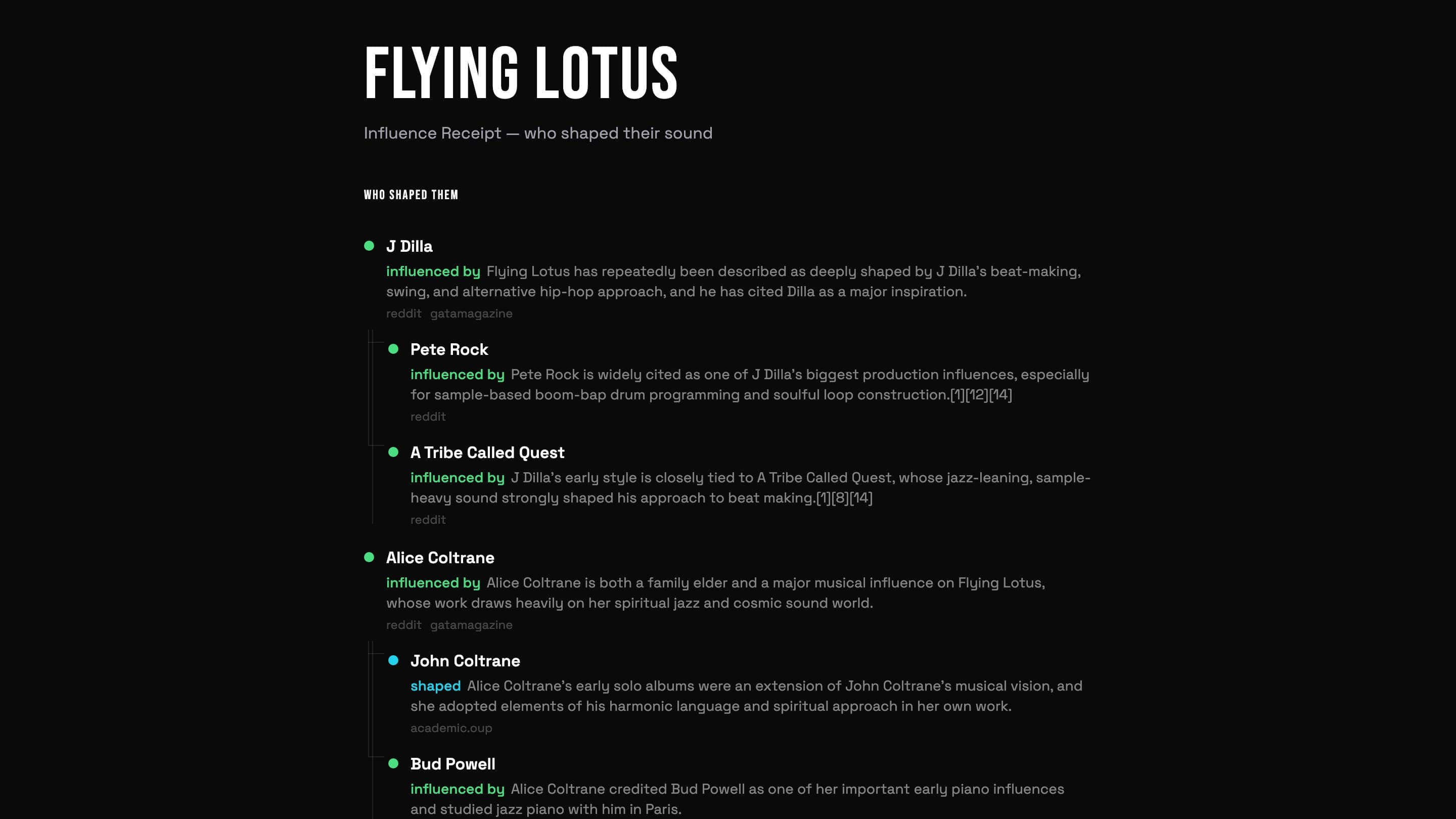
The liner notes the streaming services dropped. Why two artists are connected, with the receipts.
01
The Problem
A music obsessive who hears an artist on a Tiny Desk set and wants to know where that sound came from has no way to get an answer. Spotify has the data but ships a 40-word bio and a Fans Also Like carousel, so the only path is manually stitching together Discogs credits, WhoSampled entries and decade-old reviews across a dozen tabs. Most people just stop asking.
02
The AI Design Decision
I let the AI choose which sources to check rather than fixing the order in advance, because I don't know ahead of time which of the twenty will have the answer. A question about a sample needs one source, a question about who played on a record needs another, a question about a city's scene needs music journalism. So it picks the three that fit instead of asking all twenty every time. What I refused to do is let it write the connections from what it already knows. The AI knows a lot about music and will state a link confidently whether or not anyone ever documented it, and a made up influence doesn't just give you a wrong answer. It destroys the only thing this product sells, which is that the connection is real and you can go check.
03
The Architecture
- 01Type an artist name, no login and no account
- 02if someone asked before, the saved answer comes back instantly and costs nothing
- 03checks block bots and cap how much anyone can spend in a day
- 0420 music sources are read at once for facts
- 05the AI writes the connections, the code writes the citations, and the page shows both
04
The Responsible AI Constraint
The risk isn't the AI inventing a connection between two artists. It's a real connection quietly losing its source. The AI writes as it goes, and if it stops early because it ran long or a lookup failed, the text on screen already looks finished while the sources never got attached. You'd have a confident paragraph with nothing behind it, and no error anywhere. So the model doesn't write citations at all. It picks which sources it used, and the code renders them. Running out of room costs you a sentence now instead of the receipts. Every source also sits behind its own key, so a problem with one music service can't reach any of the others.
05
The Result
Live at digcrate.app. Shown to public radio professionals at the Non-Commercial Music Conference in April 2026 and the Public Media Growth Conference in July 2026. I use it to prepare Rhythm Lab Radio, my syndicated show, and Radio Milwaukee's Assistant Program Director uses it to prepare hers. Entered in the Auth0 hackathon with no placement, and nobody has paid for it yet. The proof so far is professional rather than commercial: the people whose broadcasts depend on getting this right are the ones using it. It holds 626 NPR Tiny Desk performances from 2021 onward, each one linked to the records behind it.
06
If you remember one thing
The AI never writes a source. It picks which ones it used and the code prints them, so a write-up that gets cut short loses a sentence instead of losing the receipts.
Tech Stack
- Next.js (App Router)
- Convex
- Perplexity Sonar
- Claude (Anthropic)
- Auth0
- OpenUI
- Stripe
Links